The George Fisher Tea Round

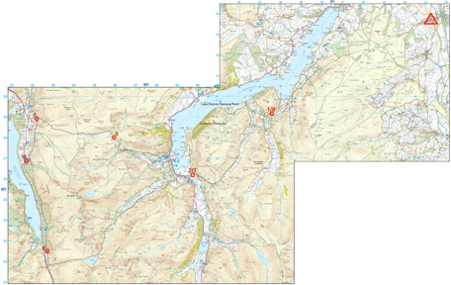
I first heard about Abraham’s Tea Round a few years ago. It’s a 46km route, with 3500m of elevation bagging Cat Bells, Robinson, High Stile, Red Pike, Whiteless Pike, Hobcarton Crag, Grisedale Pike, Eel Crag, Sail, Causey Pike, Rowling End and Barrow. You can do them in any order that you like and it used to be the case that when you finished, at Abraham’s Cafe, you were rewarded with a cup of tea. The cafe doesn’t exist anymore but the reward is now a badge and a buff from George Fisher, which suits me as I’m not much of a tea drinker. All-in-all it sounded like a great day out in the fells – all it needed was a plan.

I was up in the Lakes last December with Mark, Dave and Jonathon for the Tour de Helvellyn and we popped into the George Fisher shop, which got us talking about completing the Tea Round, and before we’d got home we’d already planned a date for us all to come back.

The first few months of 2026 brought some pretty miserable weather to the UK – grey and raining almost every day, so we didn’t have high hopes for a nice day up in the Lakes. As it turned out we had possibly the best weather I’ve ever experienced!

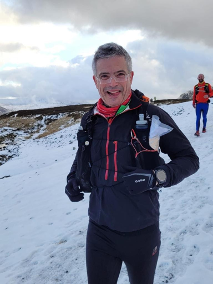
We reckoned that the route would likely take us about 11 hours to complete and we really wanted to get to the George Fisher shop before they close at 5pm. With that in mind we decided on a 5am start, which we almost managed, setting off from the front of the shop at 5:23am. It had been clear overnight, so it was -3C when we started!

The first few kilometres to Hawes End were flat, easy running, after which we started the ascent up Cat Bells. We could see quite a few head torches in front of us and it sounds like the reason was that Cat Bells is renowned for brilliant sunrises and with the clear sky today was definitely going to be a special sunrise. We made it over the top before the sun was up but there was the beginnings of a lovely red sunrise in the east.

After Cat Bells we dropped down to the west to Little Town and then the first proper climb up to Robinson. A few days before there had been some snow overnight, so above about 500m there was a light covering of snow, which combined with the clear skies and the moon was quite magical.

The climb to Robinson was quite easy but the descent on the other side down to Buttermere was very steep and quite slippy in places, but mainly along a fence line so there was something to hold on to. At the back of my mind was the knowledge that the next ascent up to High Stile was going to be even steeper and up the northern aspect, so with much more snow cover.

We all got down to Buttermere without incident and were jogging along the road when we ran over some black ice and Jonathan suddenly fell quite hard. Fortunately nothing that he couldn’t run off, so we were all still good to carry on.

Round the eastern end of Buttermere and to the start of the biggest climb of the day, which got very steep towards the end with us scrambling up icy rock. At this point I was already quite warm and was down to just shorts and t-shirt, which looked quite out of place. Eventually we made it to the top of High Stile, after which we had a nice run along the tops to Red Pike.

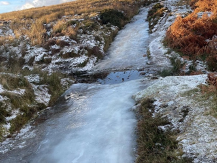
The descent from Red Pike was much easier, on a proper path, although very slippery in places where streams had frozen on the stone.

Before long we were in Buttermere village where we stopped for a can of Coke to power us up the ascent to Whiteless Pike, a familiar ascent from the Lakeland 100, but much nicer in daylight. From the elevation profile it looked like we’d have almost all the climbing done by the time we’d finished this, and so were quite surprised to see that we still had 1000m to go by the time we reached the summit.

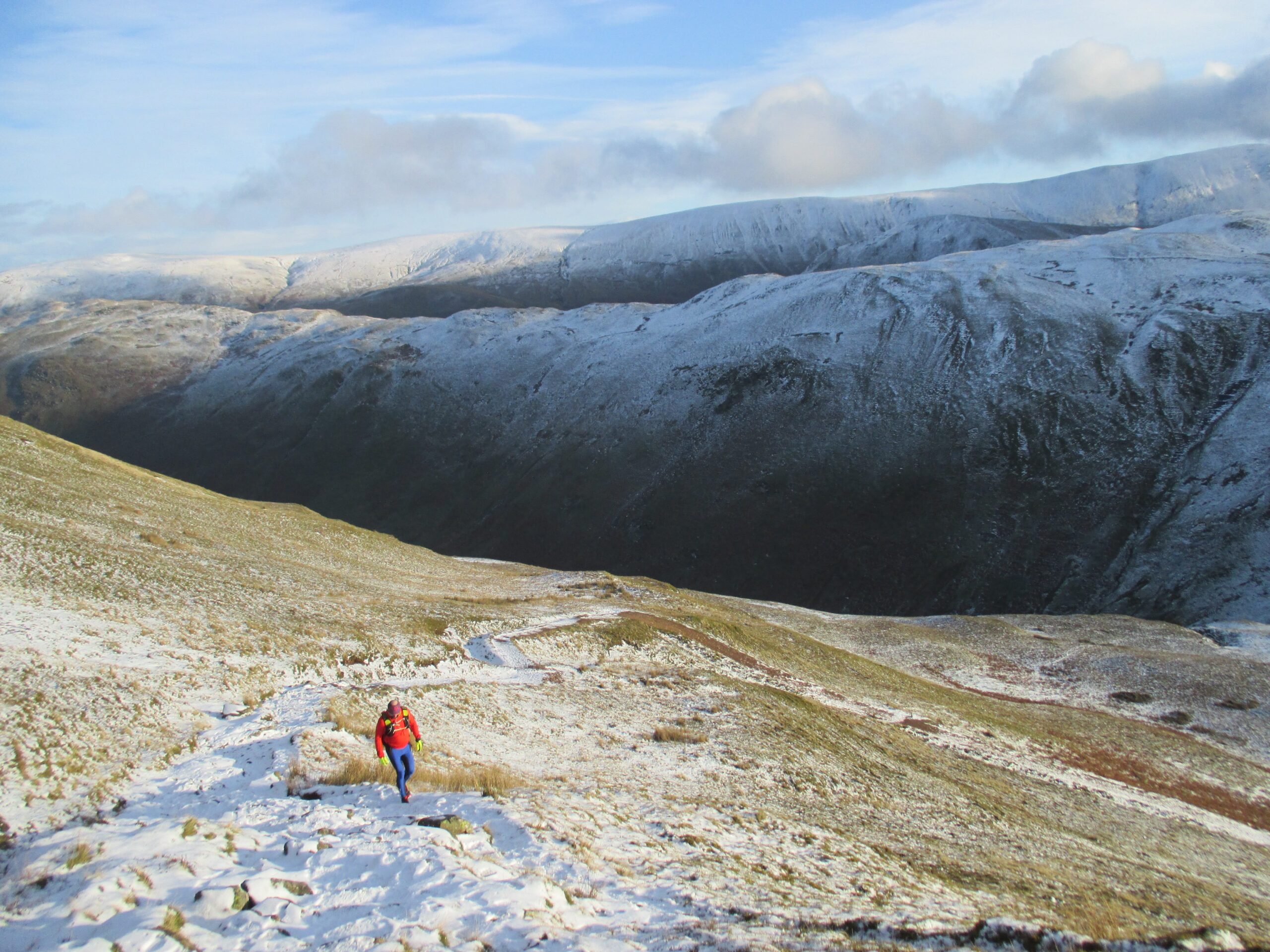
Next was a fairly easy section to the bottom of Eel Crag where we had an out-and-back to Grisedale Pike. On the way back we were looking at Eel Crag wondering how we were going to get up as it looked very steep and snow-covered, and indeed it was, with some proper icy bits.

Once we’d crested the top though, we had another fairly easy section over Sail and Causey Pike and out to another out-and-back to Rowling End. From here we could see the final summit, Barrow, but the route took us much further back up Causey Pike than seemed necessary. This was followed by some nasty descent and contouring through path-less heather. At this point we were all quite tired and I don’t think any of us enjoyed this section.

The climb up to Barrow was over before we knew it, and after that a nice grassy descent to Braithwaite, during which I had my only fall of the day on slippery patch of grass, which was fortunately a fairly forgiving surface to fall on.

After Braithwaite it was 5km of road back to Keswick and we managed to keep up a fairly decent pace, finishing a few minutes under 11 hours.

The weather, route and company made this one of the most enjoyable days out running I’ve ever had. It’s going to be a hard one to top, although we bumped into Rita and Hezel who’d just done the Cumbrian Traverse, which sounds like a potential follow-up.

The summits visited were:

SummitElevation
Skelgill Bank338 m
Cat Bells451 m
High Snab Bank440 m
Robinson738 m
High Stile807 m
Red Pike755 m
Whiteless Pike 660 m
Saddle Gate624 m
Thirdgill Head Man734 m
Hobcarton Crag738 m
Grisedale Pike 790 m
Eel Crag 807 m
Crag Hill839 m
Sail773 m
Scar Crags672 m
Causey Pike637 m
Rowling End433 m
Barrow455 m

Strava log: https://www.strava.com/activities/17638358300

The route: https://www.outdooractive.com/en/route/trail-running/north-west-england/abraham-s-tea-round/332437045/

13 Valleys

I first had a crack at 13 Valleys in 2023 but that had been a year fraught with injury, meaning I wasn’t in top condition at the start and ultimately dropped out at Borrowdale, just over 100km into the 184km race. My very first DNF – something I’d honestly believed I could avoid forever. I immediately entered the 2024 race and things were looking much better for that, injury-, training- and fitness-wise, until two weeks before, when I had a bicycle accident that left me with concussion and a fractured skull, meaning there was no way I could even start the race. 2025 was therefore going to be “3rd time lucky”!

Training in 2025 went fairly well, with the only injury problems early on in the year, from January to March. Training ramped up for the Saunders in July, which was a disaster for reasons other than fitness, so it was looking good for 13 Valleys at the end of September.

The weekend before I had an easy (taper) 20km run and decided to try out some new shoes that I’d bought, Inov8 Trailfly – the successor to my favourite shoe the Roclite. I had no intention of using these for the race but wanted to try them out in case they didn’t suit me and needed to be returned. They were OK on the day but in the days that followed I had weird pains in my feet and ankles, and I couldn’t decide if this was caused by the shoes or just some phantom taper niggles.

I travelled up to Keswick on the Thursday to have a night at the YHA and a lazy day before the race start at 6pm on the Friday. Knowing I was going to be running through two nights I was desperate for a good long sleep but woke up at 4:30! Managed to doze until 7 and then got up – not really the sleep I’d wanted but it would have to do.

By lunch time I’d registered and now just had to wait until 6pm for the race to start. There was a “shake out” run at 3pm which I decided to join just to make sure that the pack felt comfortable, but when we set off I immediately felt quite out of place as only two of us were 13 Valleys runners, the rest were all competitors in the 5 and 7 Valleys, who would only start their races the following morning. It was meant to be an easy 5k but the pace felt a bit too rapid so I turned round and headed back alone deciding to conserve energy. The pack felt fine but my feet really didn’t, which was a concern.

Lining up at the start

Eventually it was approaching the start time and we all lined up. There were 280 entries this year, much more than the 97 of 2023. 6pm and we were off, out through Keswick and along the side of Cat Bells just above Derwent Water. Nice easy trails for 15km to Honister, the first aid station, where I spent just 1 minute before heading out on the next section to Wasdale Head. 

This was going to be a little bit harder than in 2023, as the aid station at the Black Sail YHA had been dropped, but it was still only 14km, just with two climbs, the first over to Buttermere and the second up Black Sail before descending to Wasdale Head.

During this stage, at the start of a steep descent, I decided it would be a good idea to tighten my laces as having your feet move around on descents can smash up your toes. I also struggled with my headtorch as it was too loose with the strap sitting on my ears, which didn’t feel great. Stopping in the dark to try and fix it didn’t seem worth it, so I just pushed on to Wasdale and arrived feeling fairly OK. It was during this section that we got past the point where there was less than 100 miles to go. I thought that might be a good motivator, but it wasn’t really.

I spent a bit longer at Wasdale, sorting out my headtorch in the light and grabbing some food and water, so just 10 minutes before setting off again to Eskdale.

The next section is a relatively easy one although once you’ve climbed out from the Wasdale Valley the area around Burnmoor tarn is quite boggy and if you get it wrong you can end up knee deep in bog with very wet feet. Although I avoided the worst of it, I still ended up with wet feet. 

The aid station at Eskdale was very welcome with hot food – a Katsu Curry pot, which really hit the spot. I spent 25 minutes here enjoy the food and a sit down as the next section to Coniston was a long one – over 22km with a tough section up to and along Walna Scar Road. I don’t know why this feels so hard as the Lakeland 100 follows a similar route in the opposite direction and I remember that being so much easier. It was similarly tough in 2023, so this wasn’t just a bad day – it’s harder going east.

I reached Coniston in the dark, which meant I must have been ahead of my previous attempt when I’d seen the dawn here. Another sit-down and mushroom soup before heading out on an easier leg to Wray Castle on the side of Windermere via Hawkshead.  During this section my feet were really starting to get quite sore, but on the tops, very much what I’d been experiencing during the week since last Sunday’s run. Given that there weren’t going to be any steep descents I decided to slacken off the laces and that made a world of difference.  

Towards Windermere

The next section, Wray Castle to Stickle Barn, was another easy one, with rolling hills and only 12km with quite a bit of road. I did manage to miss a couple of turns here but realised fairly quickly so it didn’t cost much time. 

Climbing out of the Langdale Valley

A brief stop at the Stickle Barn aid station before setting off on a tough section up the Langdale Valley to Angle Tarn and Styhead Tarn. This is a good climb and I was feeling strong, but the descent on the other side down to Seathwaite in the Borrowdale Valley was hard work. Next an easy section over farm fields to Rosthwaite, which was the aid station where I’d quit two years earlier. There was no chance of that happening this time around. I was still feeling pretty strong and was much further in front of the cut-offs than I was the last time. Manning the aid station was the same German chap who was here last time – the one who’d talked me into quitting in 2023. Amazingly he remembered me from back then and also remarked that I was in much better shape this year, which was a boost.

Over into Borrowdale

Leaving Rosthwaite was out into the unknown as the section to Grasmere is one I’ve not experienced on any race or walk. It started off with an easy ascent up the valley, which gradually steepened, finishing with a scramble up Lining Crag to Greenup Edge. I always enjoy scrambling as it’s interesting and you make lots of upward progress in a short time. By the time I reached the top it was going dark, and the rain started, quickly getting quite heavy. Knowing it was only a few kilometres to Grasmere where I had fresh clothes meant it didn’t bother me at all. I was really looking forward to a hot meal and a change of kit from my drop bag.

The Grasmere aid station was a bit of a disappointment. It was quite small, with perhaps just a dozen chairs, and the sleeping facilities were tents outside with some damp mattresses, which didn’t appeal but I wasn’t ready for sleep yet anyway.

Here I had some blisters attended to, had a full change of clothes and shoes plus a few helpings of pasta. There were two other runners here, Chris and James, who I’d been running with occasionally up until now and James had decided to quit. I tried the usual question of “how will you feel about that decision tomorrow?” but he wasn’t to be swayed. Chris then announced that he was pairing up with me, in such a way that it sounded like I didn’t have a choice, although I’m sure he didn’t mean it like that. I would definitely welcome company for the second night, which was going to be tough with two big climbs, so I was happy to oblige.  

After a little over an hour we left Grasmere for the easy leg to Troutbeck. The first few kilometres alongside Grasmere and Rydal Water, through Ambleside and then a little climb up to the aid station. All quite easy but now we hit the crux of the race, the two big climbs up to High Street and Sticks Pass, once these were out of the way it was “in the bag”.

We set off from Troutbeck, initially heading downhill, which isn’t what you want when the biggest climb is coming – you really resent that downhill for adding more climb! The climb was initially gentle but the final 2.5km were painfully steep gaining 550m. Here Chris’s climbing ability far outclassed mine and he was often far enough in front that I couldn’t see the light from his headtorch. He did keep stopping though so I would catch glimpses. Since Ambleside the trail had been marked for the 5 Valleys runners, so navigation was really easy, just keep your eye out for the pink flags with reflective white bands. During the climb I spotted a giant one of these with Chris sitting next to it, which seemed a bit odd, but when I approached it was just a normal sized flag next to a rock – clearly the hallucinations had started.

Eventually the beacon at the top became visible in the mist and the climb was done. A fairly flat section on top and we could start the descent down to the filter house. This was some really nice grassy trail that I flew down and before long a red apparition appeared – the Filter House aid station brightly illuminated in red lights. 

From the path proper to the filter house was about 100m of steep trail that was very slippery. I fell here twice – the only two falls on the whole route.

Here Chris and I decided we really needed to try and get some sleep and we were offered sleeping mats, sleeping bags and hot water bottles. We laid down asking to be awoken in 30 minutes. The cement floor was really hard so it didn’t feel like I would be able to sleep, constantly turning to try and find a comfortable position, but sooner than expected the 30 minutes was up which must mean that I had slept at least 15 minutes.

After a bit of food we were back out on the way to Glenridding, which was another easy leg – not even 10km and mainly flat. Only a little way into this leg I realised that I really should have gone to the loo at the Filter House. I had a recollection that there was a public toilet in either Patterdale or Glenridding and so pushed on hoping to find that, but no such luck. By the time we were ascending the road up to the aid station just past the YHA I was desperate, leaving Chris a fair way behind but fortunately made it.

 The Glenridding aid station was great, with a log burner and pizza. Normally I would scoff at chicken on a pizza, but this really was fantastic. There was only one climb left now so we tore ourselves away from the log fire and set off up Sticks Pass. I’ve been up and over Sticks Pass many times as it’s on the Tour de Helvellyn route, which I do every year, and my memory was that it’s a bit of a grind up to the little bridge and then easy from then on. Chris was adamant it was the other way around with the tough bit after the bridge. He was right. 

In any case, once we were over the top of the pass it was a grassy but steep descent down into the valley and then north to St John’s in the Vale. At this point I was expecting to feel relief that the race was “in the bag” but lack of sleep was really starting to take its toll and I was struggling to keep going. I was on the lookout for a nice patch of grass where I could grab 15 minutes sleep but everything was still wet from the previous night’s rain.  Somehow Chris managed to keep me going to Threlkeld and just before the aid station we met up with his family and his stepdad ran with me for a bit, which somehow cleared the sleepiness.

Approaching Threlkeld

Arriving at the last aid station we didn’t spend much time as it was now just an easy 12km to the finish, contouring round Glederaterra Beck (just like in the Lakeland 100 but in reverse) over to Latrigg and then down into Keswick. With the end so close we got back to running for quite a bit of this. Arriving in town and running past the Moot Hall was magic, with loads of people in the streets clapping as we came through. The very last bit into the field where we’d started two days before was hard work as there was a little bit of an incline but we both kept running and crossed the finish line together. Finally I’d completed it!

Done!

There were quite a few familiar faces at the finish, which was great, but the race is lacking something here as there is no reason to hang around – everyone just wanders off once they are done. 

This was such a hard race and I’m glad it’s ticked off as I have no desire to do it again. In the immediate aftermath I decided that I was done with the long stuff, but now, just a few days later I’ve started looking at the Lakes, Meres and Waters route as a self-supported adventure next year and that’s 107 miles with almost as much elevation as 13 Valleys.

Dorking Urban Orienteering

Although I’ve been orinteering for many years now I’ve never participated in an urban event before and so thought I’d give it a try.

Being new to urban events I didn’t really know what to expect but assumed it would be more difficult than Street O, requiring more careful examination of the map and had heard that checking for uncrossable boundaries was very important.

I’d volunteered to help at the start, and for the first shift was responsible for reading out instructions to those just about to start (“Have you read the safety notices? Have you cleared and checked? …”) having repeated that close to 100 times you would have thought it would have sunk in but somehow, I managed to get into the start box without putting my dibber in the check box. Fortunately, Rob McCaffrey asked me the same list of questions, so I realised and quickly headed back to be checked before the timer beeped.

Off to control 1, initially walking to have a proper look at the map, I couldn’t tell if it would be possible to make it to the control from the north side as it wasn’t clear if there was a gap between the OOB and the fence, but I decided to give it a go, running clockwise around the fenced area and that worked out fine.

Controls 2 and 3 were easy enough but control 4 needed a bit more thought as the obvious route was blocked with a black line but there was a way in via a passage to the north. Having got to the right location it wasn’t entirely obvious to me just what was at the middle of the control circle. This was a multi-level area in the shopping centre, so I ended up running around a bit searching but fortunately not for too long.

Controls 5 – 9 all had an obvious route, so by now I was feeling pretty confident.

Heading to control 10 I was again struggling to see exactly what was at the centre of the control circle and my knowledge of control descriptions wasn’t good enough to interpret the symbols:

Sarah Scarborough enlightened me after the event, and the way to read this is:
South-eastern Wall with the control at the north-west foot.
If I’d known that I wouldn’t have been on the wrong side of the fence, at the top instead of the bottom.

The remaining controls were all relatively straight-forward, apart from #15 where I was at the wrong side of the fence – the control description makes this clear if you bother to read it! After control 20 there were a couple of long legs that a fast runner could have made up lots of time, but I was struggling to go any faster than 10min/mile, so it felt like quite a long slog. After the long run to control 21 I was unreasonably annoyed by the black line blocking the obvious route to 22, but at 1:4000 the extra loop wasn’t all that far.

For the very final control I thought I had a good plan to minimise distance by heading west-north-west up a narrow road and then taking a diagonal through the field but was foiled by a hedge and ended up turning back. Whilst doing so I saw another running doing the same thing and thought “he’s in for a surprise”. After looping back, I came into the field along the path to the south of the control and imagine my surprise when I saw the same runner leaving the control before I’d even got there. It turned out that there was a gap in the hedge that is marked on the map if you look carefully enough.

I finished the event thinking I’d done reasonably well with only a few small mistakes, so was a bit disappointed to come 17th of 17. Better nav would have saved a few minutes but not more than ten, so looking at the results I suspect that my errors only cost me one place.

Discussing the event afterwards it was clear I needed to brush up on reading control descriptions. Here are some useful resources, which I’m sure will be useful for anyone else who needs to improve in this area:

https://www.maprunner.co.uk/iof-control-descriptions

https://www.octavian-droobers.org/index.php/coaching/on-line-quizzes/articles/294-map-symbol-training

I enjoyed my first go at urban orienteering and am sure I’ll be back for more. With Forest O I regularly make nav errors that cost me tens of minutes over the course and so can still believe that with improved nav skills one day I might do well, whereas with Urban the nav errors aren’t particularly significant so I’ll need to get much faster and I don’t think that’s going to happen!

Supporting a Puddle Buckley

A running friend, Mark Simpson, as well as being a great trail runner is also a swim-runner and wanted to complete the Puddle Buckley, which is the swim-run version of the Paddy Buckley. This is a 65km trail run taking in the majority of the Welsh 3000s plus swims across four lakes.

A swimmer I am not, but as a support runner I could run the route and, at each lake crossing, run around the lake carrying Mark’s running kit whilst he was swimming. This sounded like a great day out in the hills!

When completing a round you are free to choose any start point and run the route either clockwise or anticlockwise. Mark studied the route and decided it was missing a few summits that feature on the Paddy Buckley round and, never one to take the easy option, adjusted the route such that we could bag those too (five extras). We decided to start at Capel Curig and run the route anticlockwise meaning that we would get the difficult climbs done in the first half.

Leg 1 – Capel Curig to Llyn Ogwen

Up at 4am to cook some porridge for a 5am start. The weather forecast for the day was not looking good, with heavy rain starting at 8am that was set to continue the whole day.

Leaving the barn, we were welcomed with mainly blue skies and had a lovely run up the first summit, Pen Llithrig y Wrach (799m), one of Mark’s extras, during which we were rewarded with a gorgeous sunrise.

From the first summit we had great views over to the next, Pen Yr Helgi Du (833m), along the Bwlch y Tri Marchog ridge.

After clearing the next summit, the cloud started coming in and we heard a few unwelcome rumbles of thunder – not what you want on a day out in the mountains (or swimming across lakes)! The following summits of Carnedd Llewelyn (1,064m), Carnedd Dafydd (1,044m), Carnedd Fach (960m) and Pen yr Ole Wen (978m) were all familiar territory from the Welsh 3000s and last year’s OMM. It did start raining though and was cold enough to warrant pulling out the hat and gloves. No more views on this leg, just head down and keep moving.

We took the steep descent south off Pen yr Ole Wen to Llyn Ogwen, where Mark handed me his running kit and set off to swim across the lake. I walked around to meet him at the other side and could easily see him making progress across the lake.

The swim had left Mark a bit cold, so straight back on with his running kit to start leg 2…

Leg 2 – Llyn Ogwen to Llanberis

It didn’t take long to warm up on the stiff climb up Tryfan (918m), one of my favourite mountains in Snowdonia. It is a slow climb though, taking the best part of an hour. It was still cloudy on the top but it was no longer raining and there were some signs that it might start to clear. Coming off the top of Tryfan is always hard work, with too much clambering over rocks to make any speedy progress. Before long we were at the wall on the col and starting the next climb up Glyder Fach (994 m). This is mainly up a scree slope that’s very steep but once you reach the top it’s a relatively flat section bagging the remaining Glyders, Castell y Gwynt (972m) & Glyder Fawr (1,001m). The scenery up here is quite other-worldly, feeling like something out of Tolkien – it would be no surprise to stumble across a sleeping dragon.

A few more summits, Y Garn (947m), Foel-goch (831m), Elidir Fawr (924m) & Elidir Fach (721m) before the descent to Llanberis through the remains of the old slate mine.

Just before the shore of Llyn Padarn we stopped at a café for pies and coke. Mark then swam across the lake and I ran around to meet him at the other side. At this point I realised that having Mark’s route on my watch wasn’t brilliant as I’d assumed it would be easy to find my way around but ended up running up an old railway that was a cul-de-sac. Running is a lot faster than swimming though, so I made it to the other side before Mark had completed the swim.

Leg 3 – Llanberis to Llyn Gwynant

The next leg looked easy with just six summits, although one of them was Snowdon so still plenty of elevation. The weather had improved greatly during leg 2 and we were now back to blue skies and sun but we were both low on water. We didn’t much want to spend money buying bottled water and so, running through the town, were on the lookout for a tap. We didn’t spot one but did come across a runner who was waiting outside his mate’s house, so it was easy to ask a fellow runner if we could top up our bottles.  

The climb up Moel Eilio (726m) was a nice grassy slope and then over Foel Gron (629m) and Moel Cynghorion (674m) without too much loss of elevation. From here it initially looked like we were going to contour round to the Snowdon Mountain railway but in fact we dropped right back down to 400m before starting the climb up Snowdon (1,085m) bagging Clogwyn Llechwedd-Llo (600 m) and Bwlch Glâs (998m) on the way.

A very brief stop at the top to dodge the crowds and touch the summit cairn before starting the descent down to Llyn Gwynant. At this stage our ETA at the finish was after 11pm but we were hopeful a few miles of downhill would pull that in so we’d be able to finish with a pint.

Mark’s swim across Llyn Gwynant was another where I’d wished I planned ahead as there was no lakeside path and I needed to head a fair way up the river at the end before finding a bridge to cross. Mark managed to complete the swim before I’d made it round to the exit point.

Leg 4 – Llyn Gwynant to Capel Curig

The final leg looked easy on paper with just three summits and not too much dropping down between them. The day’s climbing was taking its toll though, and progress wasn’t as quick as it should have been. We managed the three summits, Carnedd y Cribau (591m), Clogwyn Bwlch-y-maen (548m) and Moel Siabod (872m) before dark, rewarded with a fantastic sunset on the last climb.

It looked like it was in the bag now, with just an easy descent to the lake, a final swim, and another mile on the flat before we’d be back at the start.

As darkness fell, we stopped to get out our headtorches and almost immediately realised we’d gone off the route, continuing down a path that we shouldn’t be on. There was no sign of a path to follow so we struck out on a bearing to make it down to the lake. The going got tough though will some difficult rocky and heathery bits that we had to slide down.

On reaching the lake side there was no sign of Mark. After a bit of shouting in the dark we located each other. He’d descended to a cliff at the side of the lake but we managed to find a beach that he could swim from. The only problem now was that it was pitch dark with no visible references for Mark to swim to, so I needed to get around the lake to give him something to sight on. There were no paths and a rather grotty forest, so once again it would have been a benefit to have planned my route beforehand. Mark was understandably quite worried about swimming across a lake with no visibility, so I got a move on to make it round as quickly as I could and fortunately managed to find a forestry track that brought me out at a bridge that got me to the other side.

After locating the exit point I sat on a rock and put my headtorch into flash mode to give Mark something obvious to look for but realised fairly quickly that it was signalling … – – – … , which really wasn’t ideal as I didn’t need rescuing, so I just switched it back to regular always-on mode and looked out at the red dot that was Mark’s headtorch underneath his swimcap. The moon was out so it was yet another beautiful view.

Before long Mark had made it across the lake but was very cold so we got moving as quickly as possible for the final bit of run along the road to Capel Curig, where we finished just after midnight, with an elapsed time of 19:03:09. The route, for me, ended up being 72.7km with 5600m of elevation, so a tiny bit less if you were swimming the lakes.

All-in-all a fantastic adventure. Looking forward to more of the same on the Frog Graham next year!

The OMM 2023 – Snowdonia

The Original Mountain Marathon, or OMM, is a two-day navigational challenge held at the end of October each year. It’s been going since 1968, when it was known as the KIMM (Karrimor International Mountain Marathon) and comprises three linear and three score events. Competitors enter as pairs and must be entirely self-sufficient for the two days, which means carrying a tent, sleeping bags, food, a stove, clothing, etc. so quite large packs.

I first heard about the OMM when I attended a mountain navigation course back in 2015. In fact, this was also when I first heard about orienteering and subsequently joined Mole Valley hoping to improve my navigation skills. It was another 8 years before I finally made it to the start line and rather ambitiously entered the “Long Score” category together with regular running buddy Mark Simpson.  We’d both competed in the Great Lakeland 3 Day and the Saunders Lakeland Mountain Marathon as well as plenty of other running adventures and so weren’t completely out of our depth.

As the competition weekend was at the end of half-term, we planned a week’s family holiday up in Snowdonia and so had a couple of strenuous walks with the family in the days leading up to the event. My son was also desperate to go mountain biking on some rather extreme (for me) trails, so I was a bit worried about hurting myself before the OMM as I’m not nearly as good a rider as he is. Fortunately, I managed to stay the right way up and arrived unscathed on Saturday morning at Bethesda for the start.

Day 1
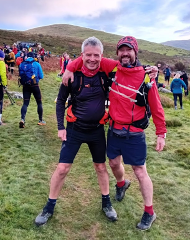
For day 1 we had a time limit of 7 hours and were hoping we’d manage somewhere between 30 and 35km but planned on seeing how far we’d gone after a couple of hours and using that as the basis for planning the remainder. At the start we looked at the map, swept out a broad circle that seemed to take in some high value controls and set off.

Here’s a portion of the map from day 1 with our route drawn in by hand:
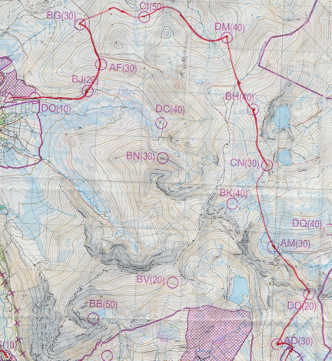
Our first three controls (DO, BJ, AF) were easy enough although they seemed to be spaced further apart than I was expecting, at which point I realised that I’d been an idiot and somehow figured that on a 1:40k map 1cm=250m, which is silly in retrospect, my only plausible excuse is that I’d been hiking with OS 1:25k maps during the week plus 4 and 25 are reciprocals so there is some sort of logic in my faulty thinking. The maps also had elevation numbers removed so if using an altimeter you needed to read the altimeter at a known location, count the contours to where you wanted to be and then remember your target elevation. Sounds easy enough but somehow I was incapable of remembering a number for more than ten minutes and always seemed to end up guessing! Maybe scribbling measured values on the map would have been the smart solution; interested to hear what others do.
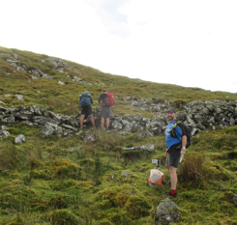
After that we did a lot of contouring round on grassy slopes to bag CI and DM, which was really hard work on the ankles and feet. After the 8th control (CN) we had what appeared to be a choice of some boggy ground for a 40 pointer (BK) or a path, marked by a dotted red line, that avoided that – we chose the path but failed to find it.  Looking at the map key after the event I noticed this:
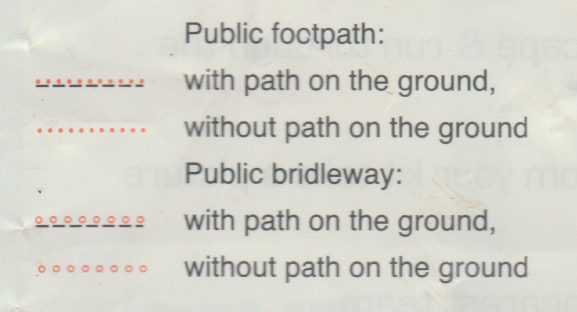
I’m guessing that’s why we never found it, but what exactly is a public footpath “without path on the ground”?

At our 10th control (DD) we bumped into Tim Scarbrough and Alex Kendall but after 5 minutes they were off into the distance and we only saw them again at the overnight camp.
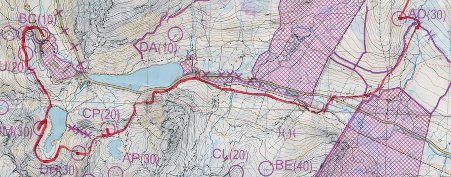
A few kilometres later we crossed the A5 into more familiar territory around Tryfan and the Glyders. We’d originally planned to bag a few controls to the east of Tryfan but our legs were getting a bit tired and that now looked like a lot of extra climbing that could easily result in us exceeding the time limit, so we decided to follow a path parallel to the road past Tryfan and then south to a few controls dotted around some llyns before heading to the finish. Here’s where I made the first nav error, turning too soon on what looked like a path climbing up but which very soon became a much more difficult climb over a boulder field. We realised the error and headed west to get to the actual path and before long were back on track.

Our next few controls (CP, DH, BM) looked easy enough on the map but in reality there were a lot of contours to climb and descend between them so it was slow going. The descent from DH to the lake got as bit hairy at when we found ourselves trying to scramble down crags with Mark falling a bit, but fortunately not too far. We made it to the overnight camp with 10 minutes to spare so it seemed we’d made some good choices after all. We’d covered 29km, so almost the 30km we’d anticipated.

For day 1 we bagged 16 controls worth a total of 440 points putting us in 54th place.
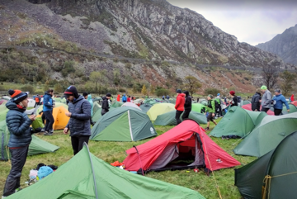
Day 2

On the second day the time limit was only an hour less: 6 hours, so still a big day out.
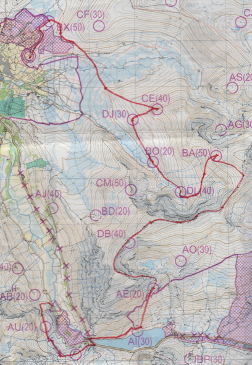
We started off returning the way we’d come into the camp the day before to bag two controls, AU and CR, before crossing the A5 where we planned to follow the edge of the lake and then up Pen yr Ole Wen for a ridge run over Carnedd Fach and Carnedd Dafydd. This probably wasn’t the smartest route choice as it only bagged us a single 40 point control (DB), but in terms of running it was the highlight of the weekend!
After that a bit of contouring to BA and then down into the valley for DL, BO and DJ, followed by a climb up to CE, which on the map didn’t look that steep but it was hard work. Then a lovely downhill run to the river before bagging the final control BX. We briefly considered climbing to CF but decided not to as we were tired and would likely incur a penalty by missing the cut-off.

We bagged 11 controls worth a total of 370 points putting us in 106th place and a final position of 74th of 195 finishers. Day 2 felt like it had gone better than day 1 but we’d actually done worse! Total time for the two days was 12:23:42.

I really enjoyed the OMM. The weather made it tougher than both GL3D and the Saunders MM, and from what I hear this year was considered to be mild by OMM standards. I’m pretty sure I’ll be back next year in the Southern Highlands to see what proper OMM weather is like.

There were quite a few other pairs I know from both the Surrey Hills Running Club and Mole Valley Orienteering Club, here are all of our results:

Tim Scarbrough & Alex Kendall         Long Score14th / 12th male
Mark Vyvyan-Robinson & Hasan UctasLong Score40th / 7th vet
Mark Simpson & John PickupLong Score74th / 57th male          
Becky Raftery & Sarah ScarbroughLong Score99th / 6th female
Barry Mcelearney & Keith MassonB19th / 7th vet h/c
Robert McCaffrey & Simon BoothB43rd / 23rd vet h/c
Philip Morgan & Rob BealeB52nd / 25th vet h/c

Tour de Helvellyn

The Tour de Helvellyn takes place every year on the Saturday closest to the winter solstice. It’s a 39 mile race that goes around rather than over Helvellyn. There is no set route, just a series of seven checkpoints that you need to visit. Here’s how it looks on a 1:25k OS map with the checkpoints marked:

Sitting in the pub the evening before the race, we were notified that ice meant that the event would be shortened this year and would be an out-and-back to checkpoint 3, missing out Sticks Pass, the western side of Helvellyn along Thirlmere and the return past Grisedale Tarn. This was quite disappointing to hear as that meant the best parts of the route were going to be missed. The event was also going to start an hour later, so that plus the disappointment lead to far too many pints in the pub that night and I was rewarded with a headache the following morning – not the best race prep!

Setting off over Askham Fell there were some excellent sections of running through snow, something that I always enjoy.

Descending a bit, it soon became clear why the route had been shortened as in areas where over the previous week there had been repeated freezing and thawing the paths had become sheets of ice that were impossible to run on; the only way to safely make progress was to run off-trail until the icy sections were over.

Bar these icy bits the route was easy to the first checkpoint at Martindale Church and then followed an uninspiring stretch mainly on road up Boredale (an apt name it seems). The fells on either side looked amazing in the snow and an idea took hold that it might be worth taking a different route on the way back to bag a couple of Wainwrights and enjoy the snow higher up. At this point I was running with Mark, who I regularly train with in the Surrey Hills, and it sounded like he might be up for a diversion too. No need to decide now as we’d get a better idea of conditions higher up after reaching the turnaround point on the way up Sticks Pass.

In to checkpoint 2, at which stage some of the faster runners started flying past, Damian Hall, Paul Tierney, …, one chap who I didn’t recognise didn’t even slow down for a cattle grid and leapt all the way over in a single stride. At the time I remember thinking “that could have gone spectacularly wrong!”

A bit more road to Glenridding and then up past the Youth Hostel to start the climb up Sticks Pass. Not to the top though as we would be turned back at checkpoint 3 about halfway up. Whilst still on the way up we got to see the fast runners a second time as they came hurtling back down.

Reaching checkpoint 3, at a little over 13 miles, we still felt fresh and conditions didn’t seem that bad, so we were definitely up for more of a challenge and thus the more interesting return route was on the cards. The best option looked to be to head north at Boredale Hause to take in Round How and Place Fell. It did feel a bit weird deliberately heading off the route that everyone else was taking, but this is a self-navigation event with no set route so, apart from being a slow option, this was completely valid as it still visited all the checkpoints.

Once up on the tops the decision proved sound, with loads of snow, great views and the trail to ourselves.

We rejoined the standard route just before the final checkpoint at Martindale Church and then an easy run over Askham Fell took to us to the finish for a bowl of Joe’s legendary soup.

All-in-all a cracking day out on the winter fells, even if it wasn’t the full route. I’ll be back again for sure and can certainly recommend this event as an antidote to the stresses of Christmas shopping.